Personalized mRNA Neoantigen Therapy Cuts Melanoma Recurrence in Phase 3

In INTerpath-001, intismeran plus pembrolizumab lowered the risk of recurrence or death by 42% in resected melanoma, with the benefit emerging only after vaccination ended.
A cancer vaccine built separately for each patient from the mutations in their own tumour has, for the first time, improved outcomes in a phase 3 trial. In INTerpath-001, adding intismeran autogene, an individualised mRNA neoantigen therapy from Moderna and Merck, to adjuvant pembrolizumab cut the risk of recurrence or death by 42% in people with completely resected high-risk melanoma, compared with pembrolizumab alone. The results were presented as the first late-breaking abstract (LBA1) of the Presidential Symposium at the ESMO Congress 2026 in Madrid, and the paper has been accepted by The New England Journal of Medicine.
The headline figure is clear, but the detail is more interesting. The benefit did not appear until the vaccination course was over, and the size of the effect depends on which analysis you look at. Both points matter for how the result should be read.
The clinical problem
Surgery removes visible melanoma, but in stage IIB to IV disease a meaningful share of patients relapse, often with distant metastases. Adjuvant anti-PD-1 therapy, such as a year of pembrolizumab, has become a standard way to lower that risk. It works by releasing a brake on T cells that already recognise the tumour. What it cannot do is create new T-cell responses against targets the immune system has not noticed.
That gap is the rationale for neoantigen vaccines. Tumours carry mutations that change the protein sequences they produce. Some of those altered peptides, called neoantigens, can be displayed on the cell surface and recognised as foreign. Because they are absent from healthy tissue, they are in principle ideal targets: a T cell trained against them should spare normal cells. The difficulty is that almost every tumour's set of mutations is different, so a single off-the-shelf vaccine cannot cover them.
How intismeran works
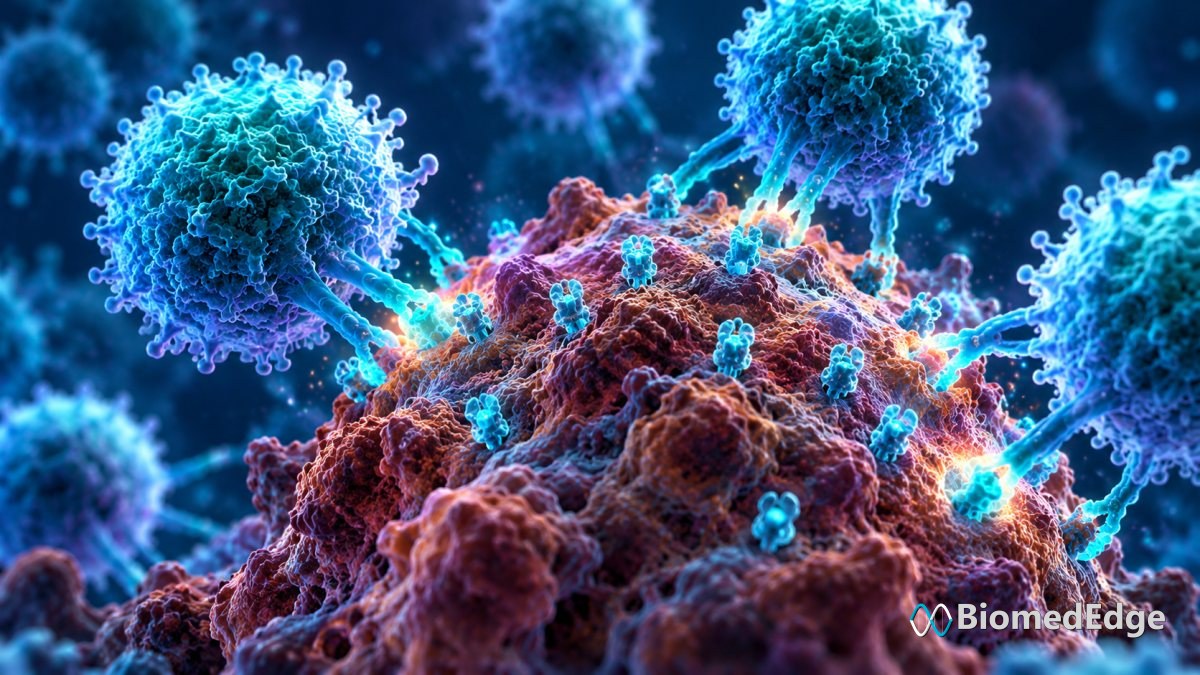
Intismeran is made for one patient at a time. DNA from the resected tumour and from the patient's normal tissue is sequenced and compared to find mutations unique to the cancer. An algorithm then ranks the candidate neoantigens, and up to 34 of them are encoded in a single synthetic mRNA molecule, delivered in a lipid nanoparticle, the same broad delivery approach used in mRNA vaccines against infectious disease.

After intramuscular injection, cells take up the mRNA and translate it into the neoantigen peptides, which are processed and presented to the immune system. The intention is to prime new T-cell clones, or expand rare existing ones, against the patient's own tumour mutations. Pembrolizumab is given alongside to keep those T cells from being switched off through the PD-1 pathway. The two parts of the combination have different jobs: the vaccine widens the range of targets, and the checkpoint inhibitor sustains the response.
The trial
INTerpath-001 (NCT05933577) is a randomised, double-blind, placebo-controlled phase 3 study. It enrolled 1,137 adults with completely resected stage IIB, IIC, III or IV cutaneous melanoma who had not received prior systemic therapy and were randomised within 13 weeks of surgery. Ocular and mucosal melanoma were excluded. Patients were assigned 2:1 to:
- intismeran 1 mg intramuscularly every three weeks for up to nine doses, plus pembrolizumab 400 mg intravenously every six weeks for up to nine cycles; or
- placebo on the same schedule, plus the same pembrolizumab regimen.
Treatment lasted about a year. The primary endpoint was recurrence-free survival (RFS), and the key secondary endpoint was distant metastasis-free survival (DMFS). The results come from a prespecified interim analysis, first announced as positive in August 2026 and presented in full at ESMO.
The evidence
At a median follow-up of 24.6 months, the intention-to-treat (ITT) results were:
- RFS: hazard ratio (HR) 0.58 (95% CI 0.45 to 0.75; p<0.001). Two-year RFS was 82.2% (95% CI 79.3% to 84.8%) with the combination and 70.0% (95% CI 65.0% to 74.5%) with pembrolizumab alone.
- DMFS: HR 0.62 (95% CI 0.45 to 0.85; p=0.002). Two-year DMFS was 88.5% (95% CI 86.0% to 90.6%) versus 80.2% (95% CI 75.6% to 84.0%).
Median RFS and DMFS had not been reached in either arm. Benefit was reported to be generally consistent across prespecified subgroups. Overall survival is not yet mature. The companies describe a favourable trend but have not released figures.
A delayed effect
The most informative result is a prespecified piecewise analysis that split follow-up at six months. In the first six months, the two arms were indistinguishable: RFS HR 0.99 (95% CI 0.66 to 1.49) and DMFS HR 1.01 (95% CI 0.58 to 1.79). After six months, the gap opened: RFS HR 0.42 (95% CI 0.30 to 0.58) and DMFS HR 0.50 (95% CI 0.34 to 0.73).
This pattern fits the biology. Nine doses given three weeks apart take about six months to complete, and a vaccine needs time to prime and expand T cells before it can affect relapse. Recurrences in the first months after randomisation probably reflect disease that was already established before the immune response could form. The analysis was prespecified, which gives it more weight than a post hoc split, but it remains a sensitivity analysis. The primary result is the ITT HR of 0.58, and the post-six-month HR of 0.42 should not be quoted as if it were.
ITT versus modified ITT
A second sensitivity analysis, in a modified ITT population that excluded patients who did not receive at least one planned dose of intismeran or placebo, gave an RFS HR of 0.51 (95% CI 0.39 to 0.67) and a DMFS HR of 0.55 (95% CI 0.40 to 0.77). Some reports have headlined the 49% reduction from this analysis. The ITT figure is the conservative and appropriate primary estimate. The difference between the two shows that some randomised patients never started the blinded treatment as planned. The reasons have not been detailed in the coverage so far, and they will be worth reading in the full paper, because an individualised product has to be manufactured before the first dose can be given.
Consistency with phase 2b
The phase 3 result is in line with the earlier randomised phase 2b study, KEYNOTE-942, published in The Lancet in 2024. At five years of follow-up, reported at ASCO 2026, that trial showed an HR for recurrence or death of 0.51 (95% CI 0.294 to 0.887) and an HR for distant metastasis or death of 0.411 (95% CI 0.200 to 0.843). The phase 3 point estimate is somewhat smaller, which is common when a therapy moves into a larger, broader population. Its confidence interval is far narrower, and it removes the main uncertainty of the phase 2b study, whose primary RFS confidence interval at the original analysis (HR 0.56, 95% CI 0.309 to 1.017) crossed 1.
Safety
Treatment-related adverse events occurred in 95.8% of patients on the combination and 90.0% on pembrolizumab alone. Grade 3 to 5 treatment-related events were similar, at 14.2% and 13.4%. The most common events with the combination were pyrexia (52.2%), injection-site pain (51.0%) and fatigue (38.5%), the reactogenicity expected from an mRNA-lipid nanoparticle product. No new safety signals were reported. In other words, the vaccine added frequent but mostly low-grade side effects without substantially increasing serious toxicity over pembrolizumab alone.
Why it matters
Therapeutic cancer vaccines have a long history of failure in late-stage trials. INTerpath-001 is the first phase 3 trial of an individualised neoantigen therapy to meet its primary endpoint, showing that a vaccine designed around one patient's tumour mutations can improve a clinical outcome. It also supports the idea behind the combination: checkpoint blockade alone leaves room for improvement, and widening the T-cell repertoire can add to it.
The result also matters beyond melanoma. Merck and Moderna are testing intismeran in nine phase 2 and 3 trials across several tumour types, including three ongoing phase 3 trials in non-small cell lung cancer and a study with BCG in bladder cancer. Melanoma has a high mutational burden, which offers many candidate neoantigens. Whether the approach works as well in tumours with fewer mutations is an open question that those trials will help answer.
Limitations and open questions
- Overall survival is immature. An RFS benefit in the adjuvant setting does not guarantee longer survival, particularly when effective treatments exist at relapse.
- The comparator is active treatment, not observation. That is a strength for clinical relevance, but it means the study measures the added value of the vaccine on top of pembrolizumab, not the vaccine alone.
- Logistics. Each dose depends on tumour and normal-tissue sequencing, neoantigen selection and individual manufacturing. Turnaround time, failure rates and cost will decide how widely the therapy can be used. These details have not been fully reported.
- Interim data. The results come from an interim analysis at about two years of median follow-up. Durability will become clearer with longer follow-up.
What to watch
The NEJM paper should report the reasons for the ITT-mITT gap, the subgroup data and the full safety tables. Merck and Moderna say they are engaging with regulators on the phase 3 findings, but have not given filing dates. The overall survival analysis, and the readouts of the lung cancer phase 3 trials, will show whether individualised mRNA vaccines can be extended beyond melanoma.
This article is for information only and is not medical advice. Treatment decisions should be made with a qualified clinician.
Sources: AJMC; Dermatology Times; OncLive; Merck; ecancer; ClinicalTrials.gov
What did you think of this article?
Found this helpful? Share it!
Comments (0)
Leave a Comment
Be the first to comment!