Orexin Receptor Agonism: A First-in-Class Approach to Narcolepsy Type 1
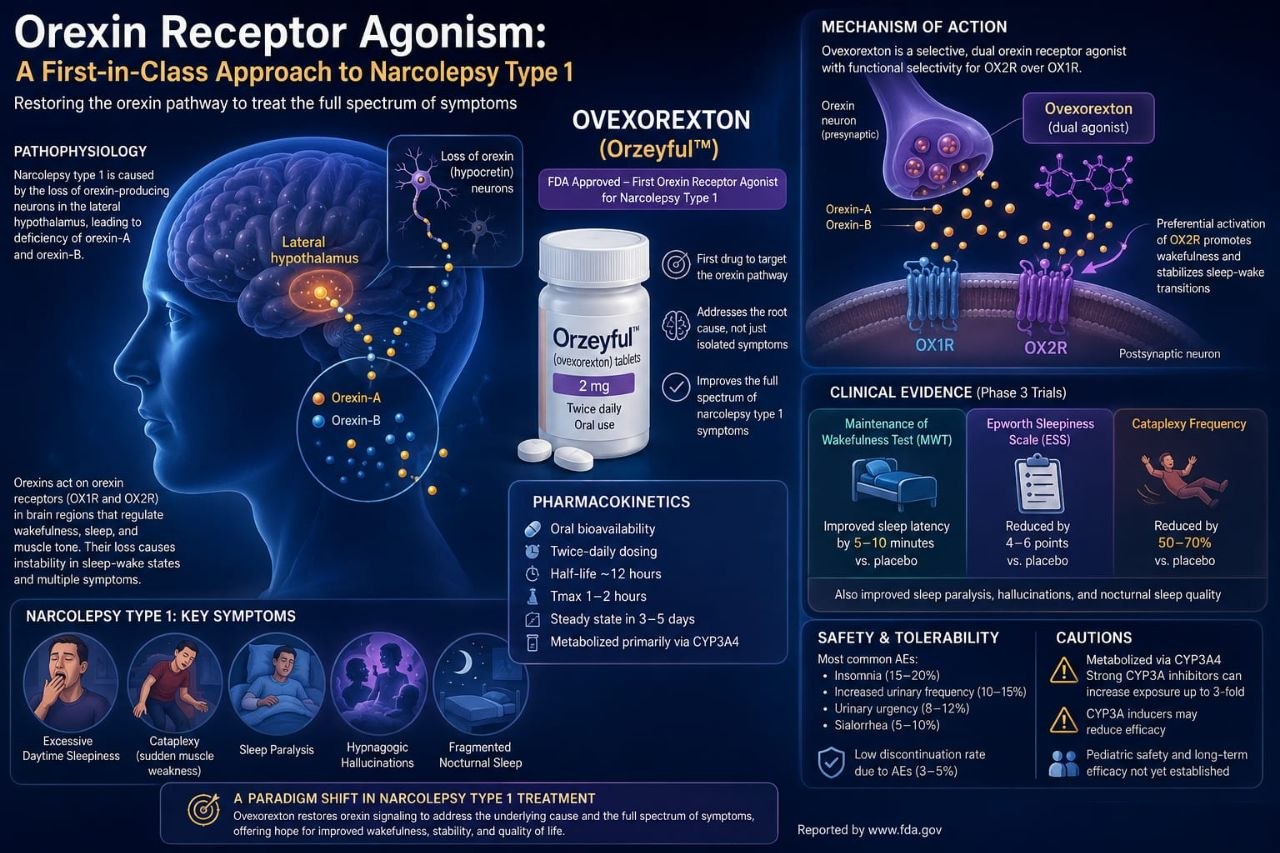
The FDA’s approval of ovexorexton marks the first drug targeting the orexin pathway in narcolepsy type 1, addressing the disorder’s full symptom spectrum rather than isolated features.
Narcolepsy type 1, a chronic neuropsychiatric disorder characterized by the loss of orexin-producing neurons in the lateral hypothalamus, has long lacked a therapeutic agent that addresses its underlying pathophysiology. The U.S. Food and Drug Administration’s recent approval of ovexorexton (Orzeyful) introduces the first drug to directly target the orexin system, offering a mechanism-based approach to managing the disorder’s full symptom profile.
Pathophysiology and Therapeutic Gap
Narcolepsy type 1 arises from the selective degeneration of orexin (hypocretin)-producing neurons, leading to a deficiency in orexin-A and orexin-B peptides. These neuropeptides act on two G-protein-coupled receptors, orexin receptor 1 (OX1R) and orexin receptor 2 (OX2R), which are widely expressed in brain regions regulating wakefulness, sleep architecture, and muscle tone. The loss of orexin signaling disrupts the stability of sleep-wake states, resulting in excessive daytime sleepiness, cataplexy, sleep paralysis, hypnagogic hallucinations, and fragmented nocturnal sleep.
Prior to ovexorexton’s approval, pharmacologic management of narcolepsy type 1 relied on symptom-specific interventions. Modafinil and armodafinil, wake-promoting agents, target dopamine reuptake inhibition to mitigate daytime sleepiness but do not address cataplexy or other symptoms. Sodium oxybate, a GABAB receptor agonist, reduces cataplexy and improves nocturnal sleep continuity but requires nighttime dosing and carries risks of respiratory depression and abuse. Antidepressants, such as venlafaxine or clomipramine, suppress cataplexy via noradrenergic or serotonergic mechanisms but are off-label and often poorly tolerated. None of these agents restore orexin signaling or address the disorder’s root cause.
Mechanism of Action: Orexin Receptor Agonism
Ovexorexton is a selective, dual orexin receptor agonist with functional selectivity for OX2R over OX1R. Preclinical studies demonstrated that OX2R activation is sufficient to promote wakefulness and stabilize sleep-wake transitions, while OX1R modulation may contribute to the regulation of muscle tone and emotional processing. By mimicking the action of endogenous orexins, ovexorexton aims to restore the signaling deficit caused by neuronal loss, thereby addressing the full spectrum of narcolepsy type 1 symptoms.
The drug’s oral bioavailability and twice-daily dosing regimen reflect its pharmacokinetic profile, with a half-life of approximately 12 hours. Peak plasma concentrations are reached within 1-2 hours post-dose, and steady-state levels are achieved within 3-5 days. Ovexorexton is metabolized primarily via CYP3A4, necessitating caution with concomitant use of strong CYP3A inhibitors or inducers, which could alter its exposure and efficacy.
Clinical Evidence and Efficacy Endpoints
The approval of ovexorexton was supported by two phase 3, randomized, double-blind, placebo-controlled trials involving a total of 273 adults with narcolepsy type 1. The primary efficacy endpoint in both studies was the change from baseline in the Maintenance of Wakefulness Test (MWT), a validated objective measure of the ability to sustain wakefulness during soporific conditions. Secondary endpoints included the Epworth Sleepiness Scale (ESS), a patient-reported assessment of daytime sleepiness, and the frequency of cataplexy episodes.
In both trials, patients receiving ovexorexton 2 mg twice daily demonstrated statistically significant improvements in MWT sleep latency compared to placebo, with mean increases of 5-10 minutes. ESS scores also improved, with reductions of 4-6 points from baseline, indicating a clinically meaningful decrease in subjective sleepiness. Cataplexy frequency was reduced by approximately 50-70% relative to placebo, and patients reported improvements in sleep paralysis, hallucinations, and nocturnal sleep quality.
While these results are promising, the trials’ 12-week duration limits conclusions about long-term efficacy and safety. Narcolepsy type 1 is a lifelong condition, and the durability of ovexorexton’s effects beyond three months remains uncharacterized. Additionally, the trials excluded patients under 18 years of age, leaving the drug’s pediatric safety and efficacy profile undefined.
Safety and Tolerability
The most frequently reported adverse events in the clinical trials were insomnia (15-20%), increased urinary frequency (10-15%), urinary urgency (8-12%), and sialorrhea (5-10%). These effects are mechanistically plausible, given orexin’s role in regulating arousal, bladder function, and salivary secretion. The incidence of treatment discontinuation due to adverse events was low (3-5%), suggesting that side effects were generally manageable.
However, the trials did not systematically assess the impact of ovexorexton on comorbid conditions common in narcolepsy type 1, such as obesity, depression, or anxiety. Orexin signaling is implicated in appetite regulation and mood, and the drug’s long-term effects on these domains are unknown. Additionally, the potential for rebound cataplexy or sleep disruption upon abrupt discontinuation was not evaluated, though such risks are well-documented with other narcolepsy therapies.
Ovexorexton’s interaction with CYP3A inhibitors is a notable limitation. Concomitant use of strong CYP3A inhibitors (e.g., ketoconazole, ritonavir) can increase ovexorexton exposure by up to 3-fold, raising the risk of adverse effects. Conversely, CYP3A inducers (e.g., rifampin, carbamazepine) may reduce its efficacy. These interactions necessitate careful medication reconciliation and dose adjustments in clinical practice.
Regulatory Context and Future Directions
Ovexorexton received Breakthrough Therapy Designation and Priority Review from the FDA, reflecting its potential to address an unmet need in a serious condition. The drug’s approval was based on a surrogate endpoint (MWT) rather than a direct measure of functional improvement or quality of life, which may limit its perceived clinical value. Post-marketing studies will be critical to evaluate its real-world effectiveness, particularly in patients with comorbid psychiatric or metabolic disorders.
The Drug Enforcement Agency’s pending scheduling decision will determine ovexorexton’s controlled substance classification, which could influence its accessibility and prescribing patterns. While the drug’s abuse potential appears low based on preclinical and clinical data, its activation of orexin receptors—implicated in reward processing—warrants monitoring.
Future research may explore ovexorexton’s utility in other orexin-deficient disorders, such as narcolepsy type 2 or idiopathic hypersomnia, though its efficacy in these conditions remains speculative. Additionally, the development of selective OX2R agonists or biased ligands could refine the therapeutic window, potentially reducing side effects while preserving efficacy.
Conclusion
Ovexorexton’s approval represents a paradigm shift in narcolepsy type 1 treatment, offering the first mechanism-based therapy to address the disorder’s underlying pathophysiology. By restoring orexin signaling, the drug provides a unified approach to managing excessive daytime sleepiness, cataplexy, and other symptoms that have historically required polypharmacy. However, its long-term safety, efficacy in pediatric populations, and real-world effectiveness remain to be established. Clinicians will need to weigh its benefits against potential side effects and drug interactions, particularly in patients with complex medical histories.
Reported by www.fda.gov.
What did you think of this article?
Found this helpful? Share it!
Comments (0)
Leave a Comment
Be the first to comment!