FDA Extends Anktiva to Papillary-Only BCG-Unresponsive Bladder Cancer

The FDA has extended Anktiva plus BCG to high-grade papillary-only NMIBC, extrapolating from carcinoma in situ data rather than a randomised trial.
On October 14, 2026, the US Food and Drug Administration expanded the label of ImmunityBio's Anktiva (nogapendekin alfa inbakicept-pmln), given with BCG, to cover adults with BCG-unresponsive, high-grade non-muscle-invasive bladder cancer (NMIBC) presenting with papillary-only tumours. The drug was first approved in April 2024 for BCG-unresponsive carcinoma in situ (CIS), with or without papillary disease. The label now spans both presentations of a disease in which the main alternative has long been removing the bladder.
The decision is notable less for what it adds than for how it was reached. The FDA did not base it on a randomised trial in papillary-only disease, which the agency had previously said would be needed. It extrapolated efficacy from the CIS cohort of the same single-arm study.
The clinical problem: when BCG stops working
Intravesical bacillus Calmette-Guérin has been the backbone of treatment for high-risk NMIBC for decades. A substantial share of patients either never respond or relapse after an adequate course, and those patients are classed as BCG-unresponsive. For them, guidelines have traditionally pointed to radical cystectomy: removal of the bladder, usually with urinary diversion. It is a major operation with real perioperative risk and lasting effects on quality of life, and many patients with NMIBC are older, with comorbidities that make it unattractive or unsafe.
Bladder-sparing options for BCG-unresponsive disease have grown in recent years. Systemic pembrolizumab was approved in 2020 and the gene therapy nadofaragene firadenovec in 2022, both for disease that includes CIS. Patients with papillary-only tumours (high-grade Ta or T1 lesions without CIS) have had fewer labelled choices. That matters because, by ImmunityBio's estimate, papillary disease accounts for roughly 85% of the NMIBC population.
How Anktiva works
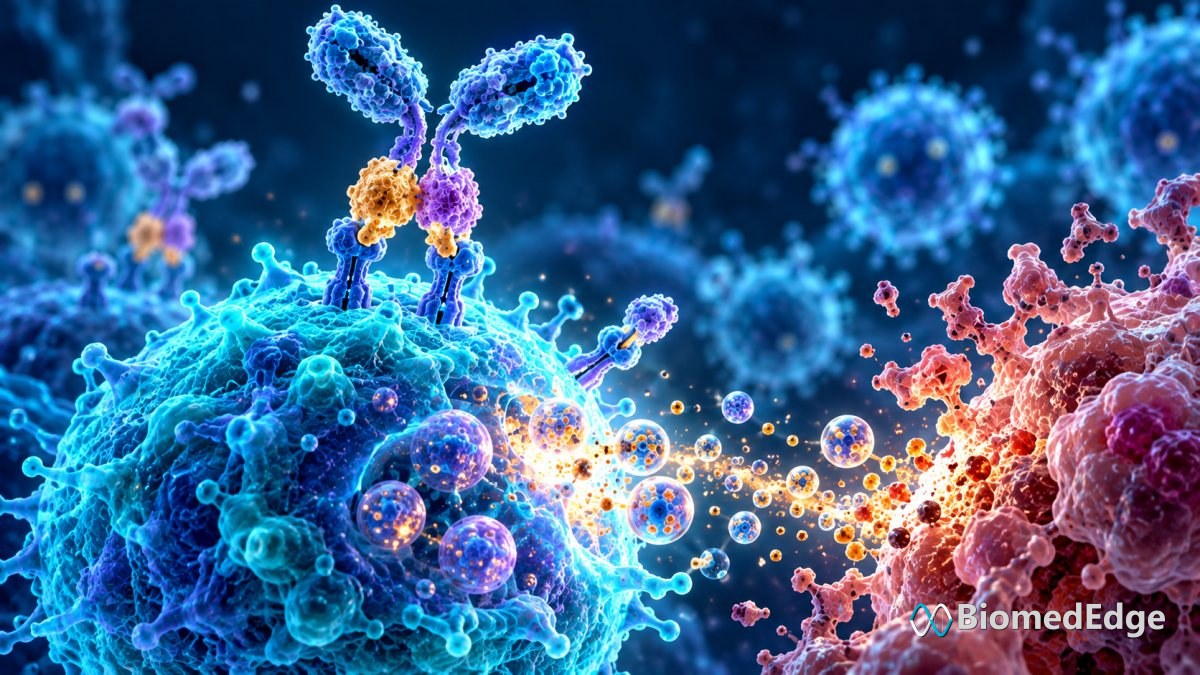
Anktiva is an interleukin-15 (IL-15) receptor agonist built as a fusion complex. It pairs a mutant IL-15 (IL-15N72D) with an IL-15 receptor alpha domain fused to an IgG1 Fc region. The design mimics the way IL-15 is naturally "trans-presented": in the body, IL-15 bound to IL-15Rα on one cell signals through the IL-2/IL-15 receptor beta and common gamma chains on a neighbouring lymphocyte. Pre-assembling the cytokine with its alpha receptor produces a more stable, more potent agonist than free IL-15.
The main targets are natural killer (NK) cells and CD8+ T cells, both of which depend heavily on IL-15 signalling for proliferation, survival and cytotoxic function. Unlike IL-2, IL-15 does not preferentially expand regulatory T cells, which is part of why it has attracted interest as an immune-stimulating cytokine.
In the bladder, the rationale is complementary to BCG. BCG provokes a local inflammatory response that recruits immune cells to the urothelium. Anktiva is intended to amplify the cytotoxic arm of that response, activating NK cells against tumour cells that have escaped T-cell recognition (for example, by downregulating MHC class I) and supporting the expansion of memory T cells. ImmunityBio attributes the durability of responses to that memory component. As with most mechanistic accounts of combination immunotherapy, that attribution is plausible but rests largely on the company's interpretation rather than on direct comparative evidence in patients.
Both agents are instilled directly into the bladder through a catheter, which keeps systemic exposure low. Per the label, treatment starts weekly for six weeks, with further courses based on response for up to 37 months. Treatment is stopped if disease persists after a second six-week course, recurs or progresses.
The evidence: one trial, two cohorts
The data come from QUILT-3.032 (NCT03022825), an open-label, single-arm, multicentre study in BCG-unresponsive NMIBC. It enrolled two separate populations:
- Cohort A: patients with CIS, with or without papillary tumours (77 evaluable patients). The primary endpoint was complete response.
- Cohort B: patients with high-grade papillary-only disease (about 80 patients). Because papillary tumours are resected before treatment, there is no visible disease left to "respond", so the primary endpoint was disease-free survival (DFS).
In Cohort A, 62% of patients achieved a complete response. Among responders, 58% remained in response for at least 12 months and 40% for at least 24 months. These are the data on which both the 2024 approval and the new expansion rest.
For Cohort B, the most recently reported 12-month DFS was 58.2% (95% CI, 46.6%–68.2%) in 80 patients. An earlier published analysis of the cohort reported 12-month DFS of 55.4% (95% CI, 42.0%–66.8%), falling to 48.3% at 24 months, with a median DFS of 19.3 months. The differing figures that circulated in coverage of the approval reflect different data cuts, not an error in either. In that earlier analysis, 5 of 72 patients (7%) had undergone cystectomy at a median follow-up of about 21 months.

Why the FDA extrapolated
The interesting regulatory question is why the agency approved papillary-only disease from CIS data rather than from Cohort B itself.
The difficulty is the endpoint. Complete response in CIS is a clean, interpretable measure in a single-arm trial: the tumour is visible before treatment, and its disappearance after treatment is hard to attribute to anything other than the drug. Disease-free survival after resection of papillary tumours is different. It is a time-to-event endpoint, and some patients will stay disease-free for a period after resection alone. Without a control arm it is hard to say how much of the observed DFS the drug is responsible for. That was the basis for the FDA's earlier position that papillary-only disease needed a randomised trial, and for the refuse-to-file letter it issued on ImmunityBio's supplemental application in May 2025.
ImmunityBio refiled in March 2026, and the application was accepted in May with a target action date of January 6, 2027. The approval arrived nearly three months early. The agency's stated rationale was that CIS and papillary disease share clinical and nonclinical features, so efficacy demonstrated in CIS could reasonably be expected to carry over. Notably, the FDA's announcements did not cite the Cohort B results as the basis for the decision.
The approval rests on extrapolation from CIS rather than on a randomised comparison in papillary-only disease, the evidence standard the agency had itself asked for.
Extrapolation across closely related populations is an established regulatory tool, but it is usually invoked where biology and mechanism are well understood. Its use here will likely be debated. Supporters will point to the unmet need, the low systemic toxicity of an intravesical agent, and the consistency of the single-arm data. Sceptics will note that the question the agency originally raised, how much of the observed DFS is attributable to the drug, has not been directly answered.
Safety
Because both agents act locally, the safety profile is dominated by bladder-related effects. Most treatment-related adverse events were grade 1–2 and included painful or frequent urination, urgency and blood in the urine. Urinary tract infections, musculoskeletal pain, chills, fever, and raised blood creatinine and potassium were also reported. The label carries an important caveat common to bladder-sparing therapies: delaying cystectomy in patients whose disease does not respond can allow progression to muscle-invasive or metastatic cancer, which can be fatal. Close cystoscopic surveillance remains essential.
What to watch
- Durability. DFS curves in Cohort B continue to decline over time. Longer follow-up will show whether a stable plateau of durable disease control emerges.
- Randomised data. A controlled comparison in papillary-only disease would settle the question the extrapolation leaves open, and would help position Anktiva against other bladder-sparing options.
- Patient selection. Not every patient is suited to an intensive surveillance-based, bladder-sparing pathway. How clinicians weigh this option against early cystectomy, particularly in high-grade T1 disease, will shape real-world use.
- The broader IL-15 class. Anktiva is the first IL-15 agonist on the market. Its experience in bladder cancer will inform whether cytokine-based NK-cell activation finds wider use in solid tumours.
For patients with BCG-unresponsive papillary disease, the expansion adds a labelled, bladder-sparing option where there had been few. For the field, it is a test case for how far regulators will extrapolate between related tumour presentations when randomised data are hard to obtain.
This article is for information only and is not medical advice. Treatment decisions should be made with a qualified clinician.
Sources: BioPharm International; AJMC; Urology Times; Chamie K, et al. NEJM Evidence 2023; ClinicalTrials.gov NCT03022825.
What did you think of this article?
Found this helpful? Share it!
Comments (0)
Leave a Comment
Be the first to comment!