FDA Approves Pirtobrutinib for Previously Untreated CLL and SLL
The first non-covalent BTK inhibitor moves to first-line use after BRUIN CLL-313 showed an 80% cut in the risk of progression or death versus bendamustine-rituximab.
The US Food and Drug Administration on October 2, 2026, approved pirtobrutinib (Jaypirca, Eli Lilly) as a single agent for adults with previously untreated chronic lymphocytic leukemia (CLL) or small lymphocytic lymphoma (SLL) who have no known 17p deletion. Until now the drug was used only after other treatments had failed. With this approval it becomes the first non-covalent Bruton tyrosine kinase (BTK) inhibitor available as initial therapy, a slot previously held in the BTK class by the covalent agents ibrutinib, acalabrutinib and zanubrutinib.
The decision rests on BRUIN CLL-313, a randomized phase 3 trial that compared continuous pirtobrutinib with six cycles of bendamustine plus rituximab (BR). Pirtobrutinib cut the risk of disease progression or death by about 80%. The recommended dose is 200 mg orally once daily until disease progression or unacceptable toxicity.
The clinical problem
CLL is the most common leukemia in adults in Western countries. It is a slowly accumulating malignancy of mature B cells. SLL is the same disease when it sits mainly in lymph nodes rather than blood. Many patients are diagnosed without symptoms and monitored for years before they need treatment. Once therapy is indicated, current first-line options fall into two broad groups: continuous oral BTK inhibition, or fixed-duration regimens built around the BCL-2 inhibitor venetoclax. Chemoimmunotherapy such as BR, once a standard for fitter older patients, has largely given way to these targeted approaches in the US.
BTK inhibitors work well, but they have two recurring weaknesses. The first is tolerability. Off-target kinase inhibition contributes to atrial fibrillation, hypertension and bleeding, and these effects matter in a population whose median age at diagnosis is around 70. The second is acquired resistance, which with covalent drugs most often arises through a single amino-acid change in BTK itself.
How pirtobrutinib works
BTK is an enzyme in the B-cell receptor signalling pathway. When the receptor is engaged, BTK relays the signal that promotes CLL cell survival, proliferation and homing to lymph nodes and bone marrow. Blocking it deprives the leukemic cells of that support. Patients often see a temporary rise in circulating lymphocytes as cells leave the protective tissue niches.
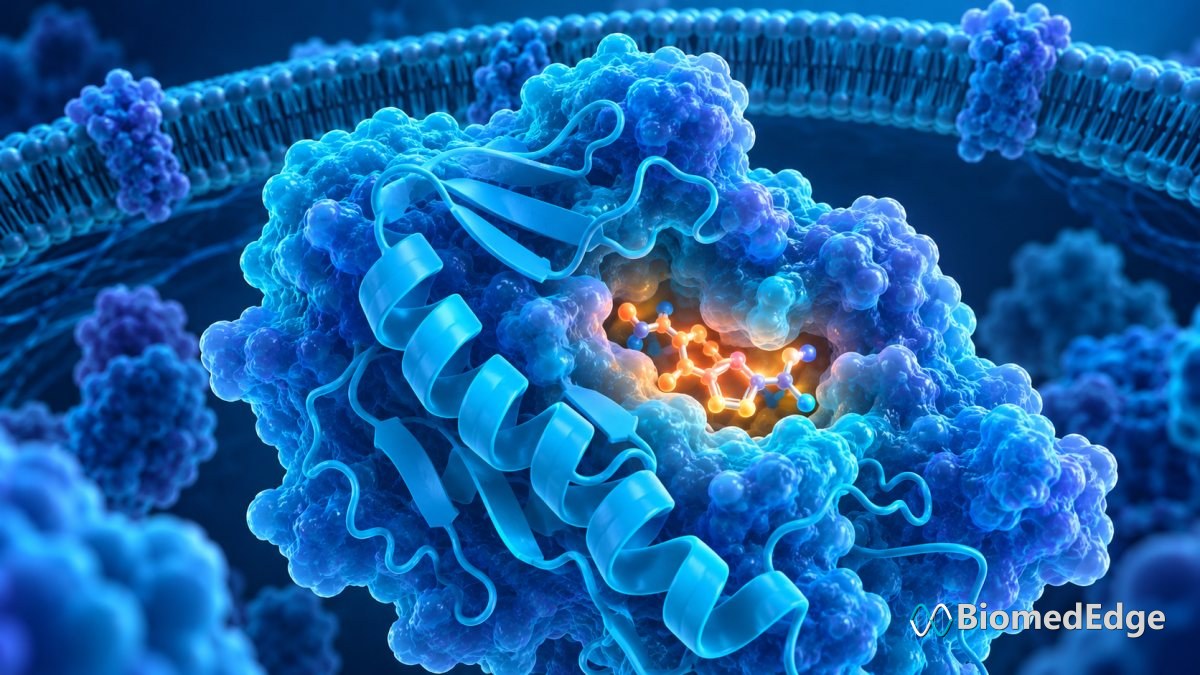
The covalent inhibitors form a permanent chemical bond with a cysteine residue at position 481 in the BTK active site. That bond gives them durable inhibition even though the drugs themselves are cleared quickly. It also creates a single point of failure. When CLL cells acquire a mutation that replaces cysteine 481 (most often with serine), the covalent drugs can no longer anchor, and their effect weakens.
Pirtobrutinib binds BTK reversibly, through non-covalent interactions, and does not depend on cysteine 481. It was designed to be highly selective for BTK and to stay in circulation long enough to keep the target inhibited across the dosing interval. In practice this means it keeps working against cells carrying C481 mutations, which is why it was first approved for patients whose disease had progressed on a covalent inhibitor. Whether reversible binding and high selectivity also bring a tolerability advantage as initial therapy is one of the questions the frontline trials were designed to answer.
The evidence: BRUIN CLL-313
BRUIN CLL-313 (NCT05023980) was an open-label, active-controlled phase 3 study. It enrolled 282 patients with previously untreated CLL or SLL whose disease did not carry a 17p deletion. Patients were randomized 1:1 to pirtobrutinib (n = 141), taken continuously, or to BR (n = 141) for six cycles. The primary endpoint was progression-free survival (PFS) assessed by an independent review committee. First results were presented as a late-breaking abstract at the American Society of Hematology annual meeting in December 2025 and published in the Journal of Clinical Oncology.
At a median follow-up of about 28 months:
- Progression-free survival: hazard ratio 0.20 (95% CI, 0.11-0.37; P < .0001). Median PFS was not reached with pirtobrutinib and was 33.5 months with BR.
- 24-month PFS: 93.4% with pirtobrutinib versus 70.7% with BR.
- Overall response rate: 94% versus 81%.
- Complete response rate: 13% with pirtobrutinib versus 21% with BR.
- Overall survival: immature. Three patients (2.1%) died in the pirtobrutinib arm and 10 (7.1%) in the BR arm.
The lower complete-response rate is not a contradiction. BTK inhibitors typically shrink disease and hold it in check rather than eradicating it, and many patients keep a partial response for years on continuous therapy. Chemoimmunotherapy produces deeper initial responses in some patients but is given for a fixed period, and relapse becomes more frequent with time, as the PFS curves here show.

A second trial: head-to-head against ibrutinib
The approval does not rely on it, but a second phase 3 study, BRUIN CLL-314, gives useful context. It randomized 662 patients who had not received a BTK inhibitor, both untreated and relapsed, to pirtobrutinib 200 mg daily or ibrutinib 420 mg daily. Published in the Journal of Clinical Oncology, it met its primary endpoint of non-inferior overall response rate: 87.0% with pirtobrutinib versus 78.5% with ibrutinib in the intention-to-treat population.
In the 225 treatment-naive patients, response rates were 92.9% and 85.8%, and an interim, descriptive PFS hazard ratio was 0.24 (95% CI, 0.10-0.59). PFS data were immature and the study was not designed to show PFS superiority in that subgroup, so these figures are best read as hypothesis-generating. Atrial fibrillation or flutter occurred in 2.4% of patients on pirtobrutinib versus 13.5% on ibrutinib, and hypertension in 10.6% versus 15.1%. Rates of grade 3 or higher adverse events overall were similar (54.8% versus 53.5%).
Regulatory significance
Pirtobrutinib's path through the CLL label has run backwards from the usual order, from late lines to first line. It received accelerated approval in December 2023 for patients who had received at least two prior lines of therapy, including a BTK inhibitor and a BCL-2 inhibitor. That was converted to traditional approval in December 2025 for patients previously treated with a covalent BTK inhibitor. The October 2026 decision extends it to patients who have had no treatment at all. The drug is also approved in mantle cell lymphoma.
The 17p-deletion exclusion reflects the trial population, not a known lack of activity. Patients with del(17p), and the frequently accompanying TP53 mutations, respond poorly to chemoimmunotherapy, so randomizing them to BR would not have been appropriate. Pirtobrutinib's use as initial therapy in that high-risk group is therefore not covered by this approval.
Safety and limitations
In BRUIN CLL-313, the most common non-laboratory adverse reactions with pirtobrutinib were upper respiratory tract infection (27%), rash (22%) and COVID-19, including COVID-19 pneumonia (21%). Decreased neutrophil count was the most common grade 3 or 4 laboratory abnormality. Serious adverse reactions occurred in 28% of patients. Grade 3 or higher treatment-emergent adverse events were less frequent than with BR (40.0% versus 67.4%), and 4.3% of pirtobrutinib-treated patients stopped the drug because of side effects. Atrial fibrillation or flutter was reported in 1.4%. The label carries warnings for infections, hemorrhage, cytopenias, cardiac arrhythmias, second primary malignancies, hepatotoxicity and embryo-fetal toxicity.
Several limitations bear on how the result is used:
- The comparator. BR is no longer a preferred first-line regimen for most US patients. Beating it shows that pirtobrutinib is active as initial therapy, but it does not show how the drug compares with the covalent BTK inhibitors or with venetoclax-obinutuzumab, which are what clinicians actually choose between.
- Open-label design. Both trials were open-label. The primary PFS endpoint in BRUIN CLL-313 was assessed by independent review, which limits but does not remove bias.
- Continuous therapy. Pirtobrutinib is taken indefinitely, with the cumulative cost, adherence burden and long-term exposure that implies. Fixed-duration options remain attractive to many patients.
- Resistance has not been eliminated. Cells can still escape non-covalent inhibition through other BTK mutations or changes in downstream signalling. The best sequence of covalent and non-covalent BTK inhibitors is unresolved.
- Follow-up is short for a disease in which patients may be treated for many years, and overall survival data are immature.
What to watch
- Longer follow-up of BRUIN CLL-313, including whether the overall-survival difference holds as data mature.
- Mature PFS from BRUIN CLL-314, particularly in the treatment-naive subgroup, and whether the lower atrial fibrillation rate is sustained.
- Guideline updates and how clinicians position pirtobrutinib against covalent BTK inhibitors and fixed-duration venetoclax regimens.
- Studies of pirtobrutinib in combination with venetoclax, which could allow a time-limited regimen.
- Resistance patterns in patients who progress on first-line pirtobrutinib, and what that means for the next line of therapy.
This article is for information only and is not medical advice. Treatment decisions should be made with a qualified clinician.
Sources: Targeted Oncology; CancerNetwork; Oncology Nursing Society; Journal of Clinical Oncology (BRUIN CLL-313); Lymphoma Hub; The ASCO Post (BRUIN CLL-314)
What did you think of this article?
Found this helpful? Share it!
Comments (0)
Leave a Comment
Be the first to comment!