FDA Approves First Pulmonary Valve That Can Be Expanded as Children Grow

The AUTUS Size-Adjustable Valve uses synthetic ePTFE leaflets on a balloon-expandable frame that widens from 12.7 mm to 22 mm by catheter, aiming to cut repeat open-heart surgery in congenital heart disease.
The US Food and Drug Administration has approved the AUTUS Size-Adjustable Valve, a surgical pulmonary valve that can be enlarged by balloon catheter after implantation to keep pace with a growing child. The agency issued the approval order on 1 October 2026 under premarket approval application P260007, held by Edwards Lifesciences. It is the first heart valve approved in the United States with synthetic polymeric leaflets rather than animal-derived tissue, and the first pediatric device to come through the agency's Total Product Life Cycle Advisory Program.
The indication is specific. The valve is for pediatric patients weighing at least 10 kg who need surgical pulmonary valve replacement for a dysfunctional native or surgically repaired right ventricular outflow tract (RVOT), where echocardiography shows severe pulmonary stenosis (right ventricle to pulmonary artery peak instantaneous gradient of 60 mmHg or more), at least moderate pulmonary regurgitation, or at least moderate stenosis combined with at least moderate regurgitation.
The problem the device is built around
Children born with tetralogy of Fallot, pulmonary atresia, congenital pulmonary stenosis and related defects often have their RVOT reconstructed in infancy. A transannular patch repair relieves obstruction but usually leaves the pulmonary valve incompetent, and years of free regurgitation dilate the right ventricle until the valve has to be replaced to protect ventricular function.
Every prosthesis available until now has had the same structural problem: it is a fixed size, and the patient is not. A valve sized correctly for a four-year-old becomes relatively obstructive as that child doubles in body surface area. The result is prosthesis-patient mismatch driven not by device failure but by normal growth, and the remedy has generally been another operation. Transcatheter pulmonary valves can address a failing conduit later in life, but they need a landing zone of adequate size, which small children do not have. The FDA's summary lists the existing alternatives plainly: a surgically placed right ventricle to pulmonary artery conduit, or a surgically or transcatheter-placed prosthetic valve. Each carries trade-offs, and none grows.
How the valve works
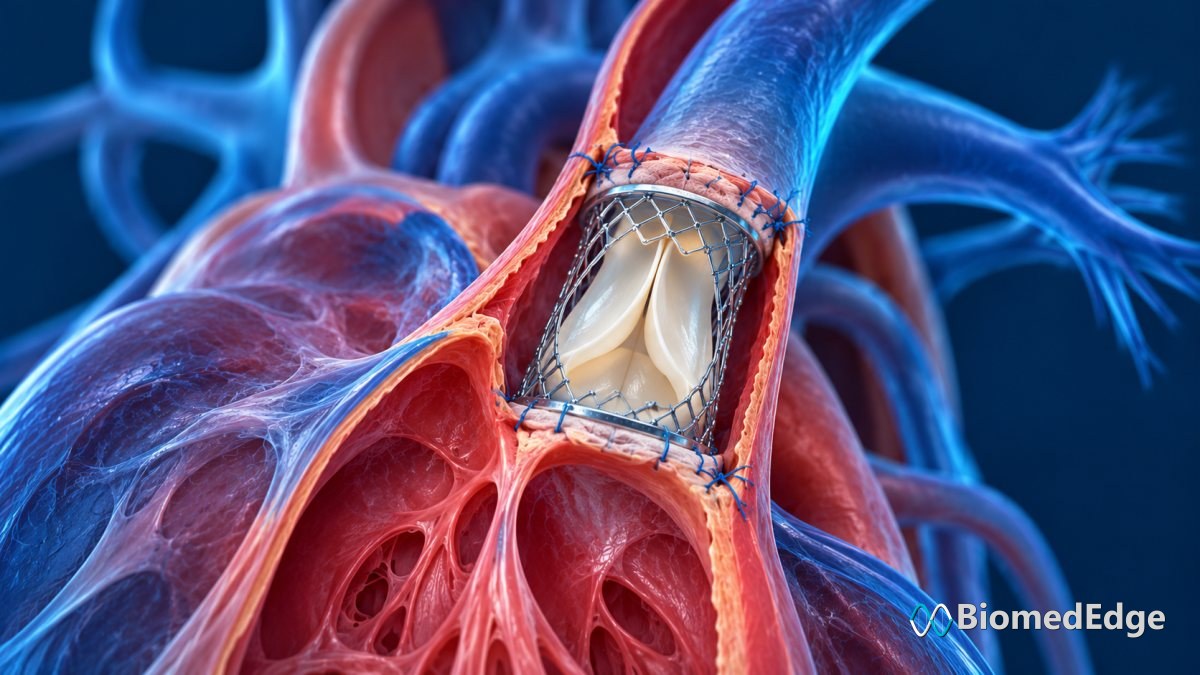
The AUTUS valve is a stented bileaflet synthetic valve. Its leaflets are 0.1 mm expanded polytetrafluoroethylene (ePTFE) mounted on a balloon-expandable 316L stainless-steel frame. The frame is encased in a sleeve of ePTFE stretch graft material that extends below the stent so the device can be sutured to tissue, and that stretches when the frame is dilated.
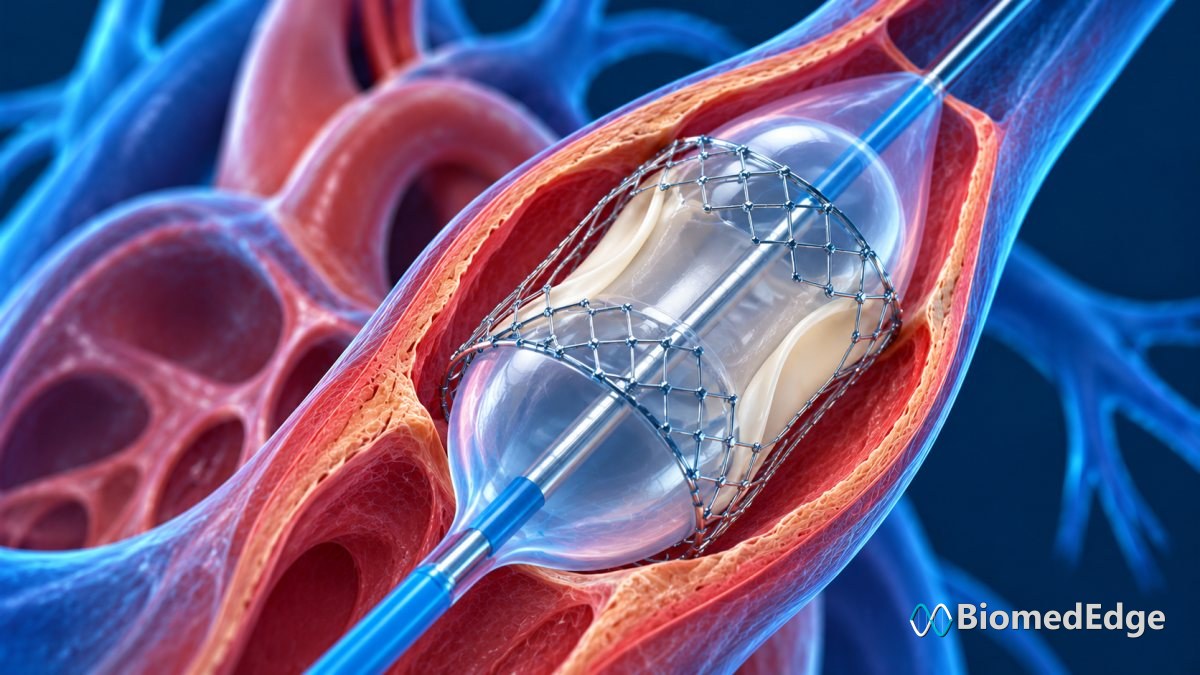
The valve is supplied in a single size, 12.7 mm internal diameter, and can be expanded in 2 mm increments either before or after implantation across a functional range up to 22 mm, comparable to an adult pulmonary valve. As the frame widens, the valve gets shorter — from 25.1 mm in length to 20.5 mm — and the coaptation height of the leaflets decreases. That is the engineering compromise at the centre of the design: the same leaflet material has to seal a progressively wider orifice, so each expansion trades some coaptation reserve for a larger effective area.
The material choices are linked. Bioprosthetic tissue leaflets are not designed to be re-dilated, and tissue valves in children calcify and degenerate relatively quickly. A synthetic leaflet is a more plausible substrate for a device meant to be stretched years after implantation. It is also an untested one in long-term clinical use, which is the main open question about the approval.
The evidence
Approval rests on a prospective, single-arm, multicentre US study under investigational device exemption G210171, in two phases pooled for analysis: an early feasibility phase of 11 subjects at three sites (December 2021 to December 2023) and a pivotal phase of 51 subjects at 12 sites (February 2024 to February 2026). Total enrolment was 62, with no control arm.
The study population was older and larger than the valve's smallest size might suggest. Median age was 8.5 years (range 1.9 to 16.2) and median weight 24.0 kg (range 10.2 to 71.7). Tetralogy of Fallot in some form was the primary anatomic diagnosis in 49 of 62 patients, and 93.5% had at least one prior cardiac operation. The dominant lesion was regurgitation, present at moderate or greater severity alone in 77.4%.
- Primary safety endpoint — freedom from device-related complication at 30 days, adjudicated by an independent clinical events committee and comprising death, valve thrombosis requiring intervention and symptomatic thromboembolism: met by 62 of 62 patients (100%), with zero events in each category.
- Primary effectiveness endpoint — acceptable haemodynamics at six months by core-laboratory echocardiography, defined as mean RVOT gradient of 40 mmHg or less, less than moderate pulmonary regurgitation, and no valve reintervention other than expansion for prosthesis-patient mismatch: met by all 60 patients who reached six months (100%).
- One year — all 51 patients who reached one year met the same haemodynamic criteria, with no valve reinterventions other than expansion for somatic growth.
Supporting measures moved in the expected direction. Mean transvalvular gradient was 9 ± 4 mmHg at discharge and 14 ± 5 mmHg at one year. At baseline 83.6% of patients had severe pulmonary regurgitation; at one year 84.3% had none, 5.9% trivial and 9.8% mild, with nobody above mild. Right ventricular end-diastolic volume indexed to body surface area fell from a mean of 91.9 ± 30.2 mL/m2 at baseline to 58.5 ± 18.5 mL/m2 at one year. The proportion of patients in Modified Ross Class I, meaning asymptomatic, rose from 58.1% at baseline to 94.1% at one year, with none in Class III or IV.
Through one year there were no deaths from any cause, no valve thrombosis, no thromboembolism, no major haemorrhage, no endocarditis and no haemolysis attributed to the device. Two patients underwent cardiac interventions the events committee judged unrelated to the valve; one was a reoperation for aortic valve endocarditis in which all intracardiac prosthetic material, including the study valve, was explanted.
What the expansion data actually show
The expansion feature is the reason the device exists, and it is also where the evidence is thinnest. Only two of the 62 patients had undergone a post-implant expansion at the time of approval.
In the first, expansion was performed 13 months after implantation. In the second, it came roughly 37 months after implantation, by which point the core-laboratory mean transvalvular gradient had risen to 44 mmHg as the child grew from 29.4 kg to 46.0 kg. After expansion that gradient fell to 31 mmHg at discharge and 14 mmHg at 30 days, with regurgitation no worse than mild. Both procedures were done by catheter rather than reoperation, and neither had intraprocedural complications.
That is a coherent demonstration of the intended mechanism, and the FDA says so, but the agency is explicit that with two cases "the small sample size limits the conclusions that can be drawn regarding the effectiveness of post-implant expansions." Nothing in the premarket data establishes how many times a single valve can be expanded, how leaflet function holds up across successive dilations, or how long an expanded valve lasts.
Safety signals and open questions
Two device-specific findings are worth attention.
Frame fracture. Three patients (4.8% of the 62 enrolled, or 5.9% of the 51 with one-year imaging) had minor stent frame fractures, all first seen on the one-year chest x-ray. None met the definition of a major fracture, which requires embolisation, haemodynamic compromise or intervention, and valve function was preserved in all three. As a condition of approval, Edwards must begin a stress-life test within 12 months to establish the endurance limit of the frame material.
Reduced leaflet mobility. Two patients (3.2%) were found on routine echocardiography to have reduced motion of one leaflet, one at six months and one at one year. Both had preserved valve function, mild regurgitation at one year, and no symptoms or evidence of leaflet thrombosis.
The FDA notes that neither finding caused clinical sequelae or reintervention, then adds the caveat that matters: "the impact of these events on post-implant valve expansion is unknown." A frame with a minor fracture, or a leaflet with impaired motion, is precisely the device that will later be dilated, and the premarket data cannot say what happens then.
The broader limitations are structural. The study was single-arm, so there is no randomised comparison with a conventional conduit or prosthesis, and follow-up is short relative to the lifetime of a child with congenital heart disease. The agency listed the absence of longer-term data and the small number of expansions among the factors it weighed in its benefit-risk determination.
What happens next
- Two post-approval studies. The premarket cohort will be followed annually through 10 years. Separately, a new prospective multicentre study must enrol at least 150 patients at up to 30 sites, with at least 40% of implants by surgeons new to the device, and follow them for 10 years. Both report descriptively rather than against a comparator.
- Expansion performance at scale. The new study's endpoints include expansion procedural success and post-expansion haemodynamics — where the central claim gets tested on more than two patients.
- Durability of synthetic leaflets. ePTFE avoids the calcification pathway that limits tissue valves in children, but its long-term behaviour in this position, and across repeated dilation, is unestablished.
- Frame endurance. The mandated stress-life testing, together with continued x-ray surveillance, should clarify whether the minor fractures seen at one year are a self-limited early finding or the start of a trend.
The valve has not been marketed in the United States or any other country before this approval, so there is no prior real-world experience to draw on. For the children in whom it works as designed, the benefit is specific: fewer sternotomies over a childhood that would otherwise involve several. Whether it delivers that at scale is a question the next decade of follow-up will settle.
This article is for information only and is not medical advice. Treatment decisions should be made with a qualified clinician.
Sources: FDA Summary of Safety and Effectiveness Data, PMA P260007; US FDA press announcement; TCTMD; ClinicalTrials.gov NCT05006404
What did you think of this article?
Found this helpful? Share it!
Comments (0)
Leave a Comment
Be the first to comment!