Base Editing Gives First Clinical Signal in Glycogen Storage Disease Type Ia

Six patients treated with Beam's BEAM-301 needed less cornstarch and fasted longer, but follow-up is short and the lower-dose effect waned.
A single intravenous infusion of a base editor has, for the first time, been reported to restore some of the liver's ability to make glucose in people with glycogen storage disease type Ia (GSDIa). On 13 October 2026 Beam Therapeutics released initial results from its Phase 1/2 trial of BEAM-301, a lipid nanoparticle (LNP) that carries base-editing reagents to the liver to correct one specific disease-causing mutation. Fuller data are due as a poster at the European Society of Gene and Cell Therapy (ESGCT) congress in Hamburg on 28 October.
The numbers are striking for a disease in which patients can become hypoglycaemic within a few hours of their last feed. But they come from six patients, an open-label design and, at the higher dose, less than four months of follow-up. What follows sets out what was reported, how the approach works, and what the data cannot yet tell us.
A disease managed by the clock
GSDIa is an autosomal recessive disorder caused by mutations in G6PC1, the gene for glucose-6-phosphatase-α. The enzyme sits in the endoplasmic reticulum of liver and kidney cells and performs the last step of both glycogen breakdown and gluconeogenesis: removing a phosphate from glucose-6-phosphate so that free glucose can leave the cell. Without it, the liver can store glucose but cannot release it. Reviews put the incidence at roughly one in 100,000 births.
The consequences extend beyond low blood sugar. Glucose-6-phosphate that cannot be released is diverted into glycogen, lactate, lipids and uric acid, so patients typically develop an enlarged liver, lactic acidosis, high triglycerides and hyperuricaemia. Over years, many develop hepatocellular adenomas and kidney disease.
Until this year, no treatment addressed the defect in the liver itself. Management has relied on keeping glucose supplied from outside: frequent meals and doses of uncooked cornstarch, which is digested slowly and releases glucose over several hours. People with the most severe forms may need starch every few hours, including overnight, and a missed dose can lead to seizures or worse. Recent work has produced two different attempts to change that.
Rewriting one letter instead of adding a gene
BEAM-301 targets a single variant, G6PC1 c.247C>T, which changes arginine 83 to cysteine (R83C). It is one of the most common disease-causing variants in GSDIa and is associated with severe disease; the R83C enzyme has no detectable phosphohydrolase activity in laboratory tests. Its frequency varies widely by population. It accounts for about half of mutant alleles in a Czech and Slovak cohort and around 80% in patients from Sicily, but it is not the dominant variant in Korea, for example.
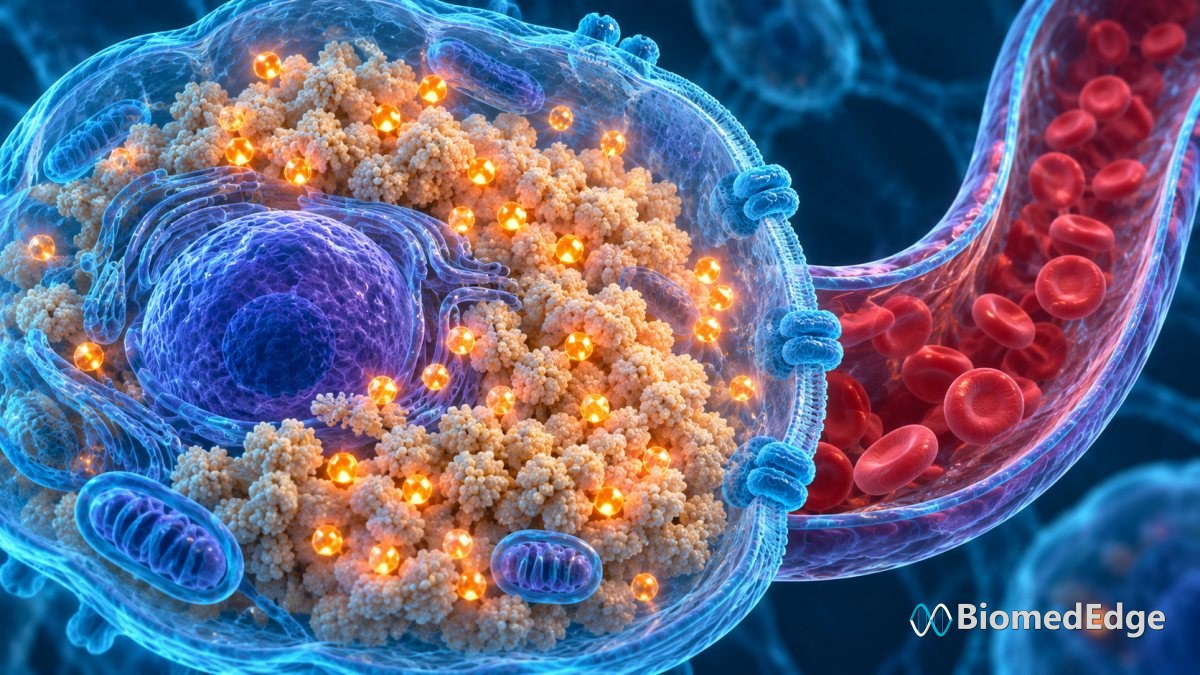
Base editors are built from a Cas9 protein that has been modified so it no longer cuts both DNA strands, fused to an enzyme that chemically converts one base into another. BEAM-301 uses an adenine base editor: mRNA encoding the editor and a guide RNA are packaged together in an LNP that is taken up mainly by hepatocytes after intravenous infusion. Once in the cell, the guide RNA directs the editor to the mutation, where it changes the faulty base back to the original sequence and restores the arginine codon at position 83. Because the edit is made in the genome of the cell, the corrected gene is under its own natural regulation and the change is intended to be permanent in the edited cells and the cells they divide into.
That is a different strategy from gene addition. In August 2026 the US Food and Drug Administration granted accelerated approval to Ultragenyx's AAV8 gene therapy pariglasgene brecaparvovec (Genglycos, formerly DTX401), which delivers a working copy of G6PC1 regardless of which mutation a patient carries. The approval rests on a reduction in daily cornstarch intake in the randomised, placebo-controlled Phase 3 GlucoGene study, and covers people aged eight and older. Gene addition works across genotypes, but AAV genomes sit largely outside the chromosomes and can be diluted as liver cells divide. Base editing is restricted to patients with the targeted variant but, in principle, keeps the correction as cells divide.
The preclinical basis was published in Nature Communications in November 2024 by researchers at the US National Institute of Child Health and Human Development and Beam. In a humanised mouse carrying the R83C variant, a single LNP dose corrected up to about 60% of the variant in liver cells, restored glucose control and allowed long-term survival. The authors reported that correction of around 10% was enough to be therapeutic, consistent with earlier observations that a small fraction of normal enzyme activity protects against fasting hypoglycaemia.
What the trial reported
The study (NCT06735755) is an open-label, dose-exploration trial in adults who are homozygous or compound heterozygous for R83C and have had at least one episode of blood glucose below 60 mg/dL in the previous two years. The registry lists three US sites and an estimated enrolment of 36. Safety and tolerability over 24 months is the primary outcome; time to hypoglycaemia in a controlled fasting challenge and change in starch intake are secondary outcomes.
By the data cut-off in June 2026, six patients had received a single infusion: three at 20 mg and three at 40 mg. Median follow-up was 313 days (range 249-453) in the 20 mg group and 53 days (range 5-110) in the 40 mg group. One patient in the higher-dose group had not been followed long enough to be evaluated for efficacy.
Fasting tolerance
- 20 mg: median time to fasting hypoglycaemia rose from 2.9 hours at baseline to 4.3 hours at day 36.
- 40 mg: from a baseline median of 2.5 hours, both evaluable patients reached at least 15 hours at day 36, which is the maximum fasting duration the protocol allows.
Because the fasting test stops at 15 hours, the higher-dose result is a floor rather than a measurement: it shows that these two patients did not become hypoglycaemic within the test, not how long they could actually fast.
Starch requirement
Prescribed starch was adjusted using continuous glucose monitoring. Compared with baseline, daily starch intake fell by 74% at day 128, 71% at day 227 and 11% at day 387 in the 20 mg group, and by 71% at day 50 and 92% at day 93 in the 40 mg group. The number of daily starch doses fell by zero to four in the lower-dose group and by two to four in the higher-dose group. Triglyceride levels at last follow-up were similar to baseline.
Beam's chief medical officer, Amy Simon, described the results as the first clinical evidence that a single in vivo treatment can restore endogenous glucose production in GSDIa. That is the company's interpretation. Direct measures of editing in the liver or of enzyme activity were not part of the released summary.

Safety and limitations
Every patient had at least one treatment-emergent adverse event judged to be related to BEAM-301. Five serious adverse events were reported, including three grade 3 infusion-related reactions, all of which resolved within two to ten days. There were no dose-limiting toxicities and no deaths. The company describes the profile as consistent with other LNP-delivered therapies, for which infusion reactions and transient liver-enzyme rises are known risks.
Several limits deserve attention:
- Size and design. Three patients per dose group, only two evaluable at 40 mg, no control group and outcomes partly shaped by clinicians adjusting starch prescriptions in an open-label setting.
- Durability. The 20 mg group's starch reduction fell from 74% to 11% over about a year. Whether that reflects a fading effect, a dose too low to be stable, changes in how starch was prescribed, or variation between individuals is not explained in the initial release. It is the most important open question for a therapy that is meant to be one-and-done.
- Short follow-up at the higher dose. The most impressive results come from patients followed for weeks to a few months.
- Permanence. An edit made in the body cannot be withdrawn. Off-target editing, long-term liver effects and the interaction with the adenomas common in GSDIa will need years of monitoring, as the trial's 24-month primary endpoint and regulators' long-term follow-up expectations for gene editing reflect.
- Eligibility. The approach only helps patients carrying R83C, and the trial currently enrols adults only.
Why it matters beyond GSDIa
Most in vivo editing programmes in the clinic so far have used CRISPR nucleases to switch a gene off, as in the approaches to transthyretin amyloidosis, hereditary angioedema and LDL cholesterol. BEAM-301 belongs to a smaller group that aims to repair a specific mutation in place, restoring a protein's normal function rather than removing one. If the effect holds, it would support the idea that one LNP-delivered editor can fix a common recurring variant in a recessive liver disease. The same platform could then be applied to other variants and other metabolic disorders, each with its own guide RNA.
It also creates an unusual comparison. GSDIa now has an approved gene-addition therapy for patients aged eight and older, and an editing approach in early trials for a genetically defined subset. The two differ in eligibility, in how long the effect may last, and in their risks. AAV therapies raise questions about immune responses and re-dosing, while editing raises questions about permanence and off-target changes. Clinicians and patients will eventually have to weigh those differences.
What to watch
- The ESGCT poster on 28 October, and whether it adds longer follow-up for the 40 mg group or direct measures of editing or glucose production.
- An explanation for the declining starch reduction in the 20 mg group, and whether higher doses avoid it.
- Whether further dose cohorts open, as the registry allows up to four dose-exploration groups.
- Longer-term liver safety, including liver enzymes and adenoma monitoring.
- How regulators view starch reduction as an endpoint for editing therapies, given its use for the accelerated approval of gene addition.
This article is for information only and is not medical advice. Treatment decisions should be made with a qualified clinician.
Sources: CRISPR Medicine News; Drug Discovery World; Beam Therapeutics (GlobeNewswire); ClinicalTrials.gov NCT06735755; Nature Communications (2024); American Pharmaceutical Review
What did you think of this article?
Found this helpful? Share it!
Comments (0)
Leave a Comment
Be the first to comment!