In Vivo CAR-T: First Clinical Data Show It Works, but Not for Long
Two October papers pull together every trial of CAR T-cells made inside the body: 41 patients, responses in all four myeloma cases, and a median progression-free survival of four months.
Two papers published in the first half of October 2026 give the clearest picture so far of CAR T-cell therapy made inside the patient's body rather than in a factory. A systematic review in BMC Cancer, published on October 16, pulled together every clinical trial of in vivo CAR T-cell therapy reported up to the end of July: seven trials and 41 patients in total. Ten days earlier, a group at Wuhan published 15-month follow-up in Nature Medicine on the first four patients ever given an in vivo CAR-T product.
Together they show that the approach works biologically, and that its central problem is not getting the cells made but keeping them around.
Why make CAR-T cells inside the body
Conventional CAR T-cell therapy is a manufacturing process wrapped around a patient. T cells are collected by leukapheresis, shipped to a facility, genetically modified to carry a chimeric antigen receptor, expanded over days to weeks, tested, and shipped back. Before the cells are returned, the patient is given lymphodepleting chemotherapy to clear space for them.
That chain is effective but slow, expensive and fragile. The Nature Medicine authors cite a US real-world study of patients with relapsed or refractory multiple myeloma who were listed for commercial BCMA-directed CAR-T: within 12 months, fewer than 40% had actually received the therapy, and 26% died while waiting.
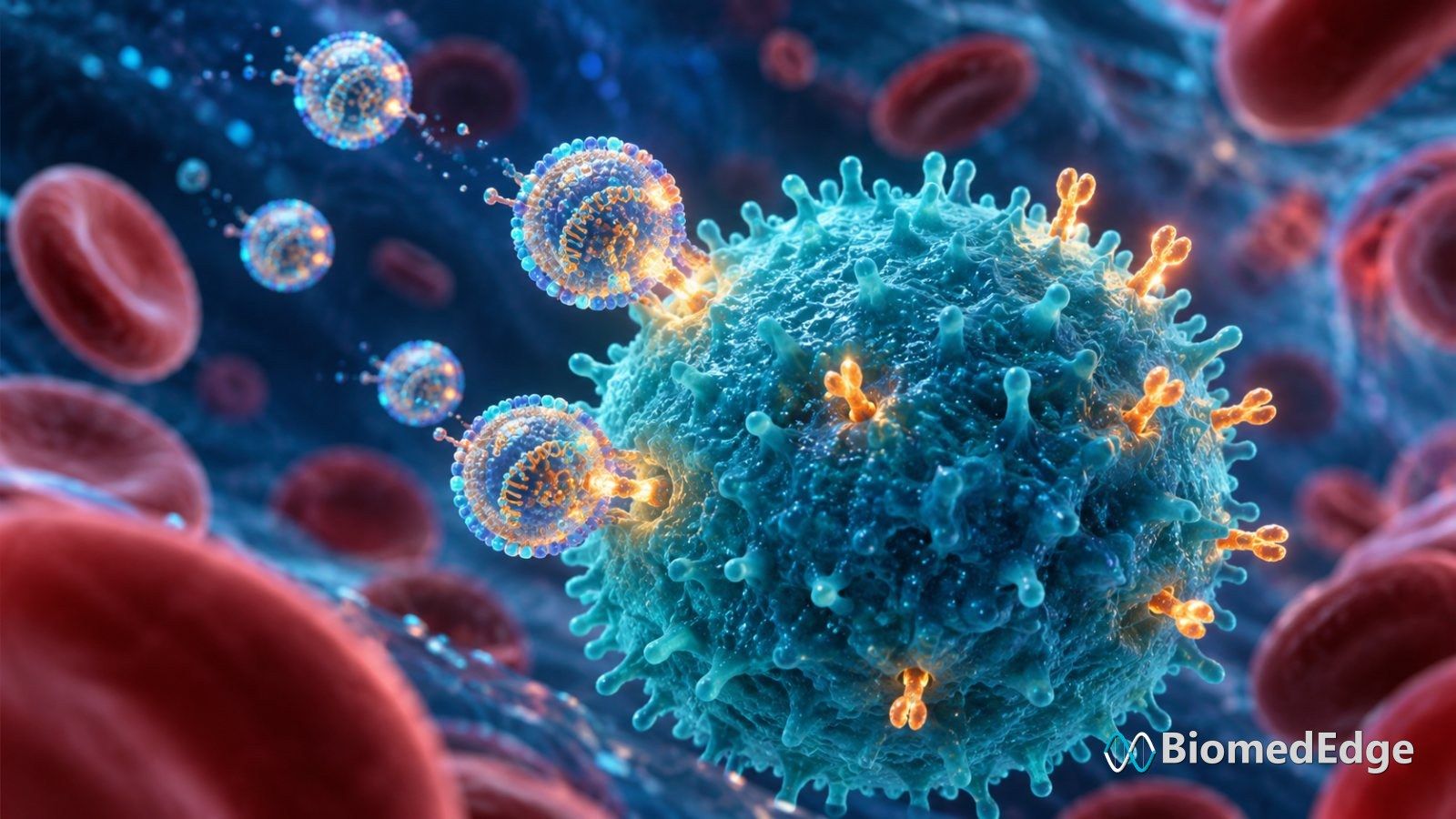
In vivo CAR-T removes the factory. The genetic instructions for the receptor are injected directly into the bloodstream inside a delivery vehicle that homes to T cells, and the patient's own cells are reprogrammed where they are. There is no apheresis, no manufacturing slot, and in the trials so far no lymphodepleting chemotherapy.

Two delivery routes
Of the seven trials in the BMC Cancer review, four used lipid nanoparticles carrying CAR messenger RNA and three used lentiviral vectors. The distinction matters clinically.
- Lentiviral vectors integrate the CAR gene into the T cell's own DNA, so the receptor is expressed for as long as the cell and its descendants survive. Integration also carries a theoretical risk of disrupting a host gene, which is why these products are followed for insertional events.
- Lipid nanoparticles deliver mRNA, which is read by the cell and then degraded. Expression is transient by design, which limits long-term genetic risk but means the effect fades and dosing may need to be repeated.
Both approaches need to reach T cells specifically rather than the liver, where nanoparticles naturally accumulate. Developers do this by studding the delivery particle with antibody fragments against T-cell surface markers such as CD3 or CD8. AbbVie's CPTX2309, acquired with Capstan Therapeutics in 2025, is a CD8-targeted nanoparticle carrying mRNA for a CD19 receptor.
What the clinical data show
The BMC Cancer review, by Elham Mahmoudi and colleagues at Iranian medical universities, searched the literature and the ASH, ASCO and EHA abstracts through July 31, 2026. Of the 41 patients, 33 had blood cancers, mainly B-cell non-Hodgkin lymphoma and relapsed or refractory myeloma, and eight had autoimmune disease. CAR T-cells were successfully generated inside the body in every study. Clinical activity could be assessed in 37 patients and included complete responses and clearance of minimal residual disease in myeloma, objective responses in lymphoma, and reduced disease activity in the autoimmune cohorts.
The most informative single dataset is the Wuhan follow-up of ESO-T01, a lentiviral product targeting BCMA, developed by EsoBiotec. Four patients with relapsed or refractory myeloma received a single intravenous dose, without leukapheresis or lymphodepletion. These were heavily pretreated patients: a median of four prior lines, all four with extramedullary disease and bulky plasmacytomas larger than 5 cm, one with penta-refractory disease.
All four responded, two with a stringent complete response and two with a partial response. But durability was poor. Median progression-free survival was 4.0 months. Three patients relapsed at three, three and five months, all with extramedullary involvement, and all three subsequently died: one of infection during salvage chemotherapy, one of disease progression, and one of intracranial hemorrhage. Salvage treatment extended overall survival to between 5.5 and 10.9 months after infusion. One patient remained in stringent complete response at 15 months.
The kinetics point to why. In two patients, relapse coincided with CAR T-cells becoming undetectable in the blood. The authors conclude plainly that the limited persistence they observed means the platform needs further optimization.
Safety
Across the review, cytokine release syndrome occurred in 24 of 31 patients in the studies that reported numerical incidence, and was usually low grade, though severe events occurred. Neurotoxicity was uncommon, with a single grade 1 event.
The ESO-T01 patients show the pattern in detail. All four developed cytokine release syndrome in two distinct phases, grades 1 to 3: an early reaction to the vector itself, with fever, low oxygen and low blood pressure, and a later episode as the new CAR T-cells expanded. All four had grade 3 or worse blood count toxicity, including neutropenia in 75%. One patient had grade 1 neurotoxicity. Three of the four had recovered to grade 2 or better blood counts by one month. Over 15 months, no toxicity attributable to vector immunogenicity or to genomic integration emerged.
That last point is reassuring but rests on four patients followed for just over a year, which is far too little to characterize the risk of an integrating vector.
Limitations
- Very small numbers. Forty-one patients across seven trials, most of them phase 1 dose-finding studies, with no control arms and no comparison against conventional CAR-T.
- Short and uneven follow-up. The review's authors note that heterogeneous cohorts, short follow-up and platform-specific toxicities rule out any conclusion about comparative effectiveness or durability.
- Durability is unproven. The only dataset with long follow-up showed a median progression-free survival of four months in patients with high tumor burden.
- Selected populations. Early trials enrol patients who have exhausted other options, which makes response rates hard to generalize.
- Reporting is inconsistent. The review calls for standardized reporting of cell kinetics and toxicity grading so that platforms can be compared at all.
- Commercial disruption. The ESO-T01 trial was discontinued after AstraZeneca acquired EsoBiotec, so the longest-running dataset in the field has no continuation.
It is worth noting what the four-patient myeloma study does not claim. Its value is as a proof of mechanism, not evidence of benefit over existing therapy. One of the patients who progressed went on to receive a conventional ex vivo CAR-T product and achieved a durable response with strong cell expansion, a reminder that the established approach remains the benchmark.
What to watch
- Whether persistence can be improved, through vector design, dose or the T-cell subsets targeted. The one durable response in the Wuhan series came in the patient with the lowest tumor burden, whose cells showed a naive and central memory phenotype.
- Results from the larger phase 1 programs now recruiting, including lentiviral products from Umoja Biopharma with AbbVie, Interius BioTherapeutics, Kelonia and Legend Biotech, and nanoparticle programs from AbbVie and Myeloid Therapeutics.
- Autoimmune disease, where the bar is a temporary reset of B cells rather than permanent tumor eradication, and transient mRNA expression may be sufficient.
- How regulators handle products with no cell product to test before infusion, since release testing assumptions built for manufactured cells do not apply.
- Long-term monitoring for integration-related events in the lentiviral programs.
This article is for information only and is not medical advice. Treatment decisions should be made with a qualified clinician.
Sources: BMC Cancer (systematic review); Nature Medicine (ESO-T01 extended follow-up); Biomarker Research (delivery strategies review); AbbVie
What did you think of this article?
Found this helpful? Share it!
Comments (0)
Leave a Comment
Be the first to comment!