Ono Licenses Biohaven's IgG Degraders: What the MoDE Platform Does
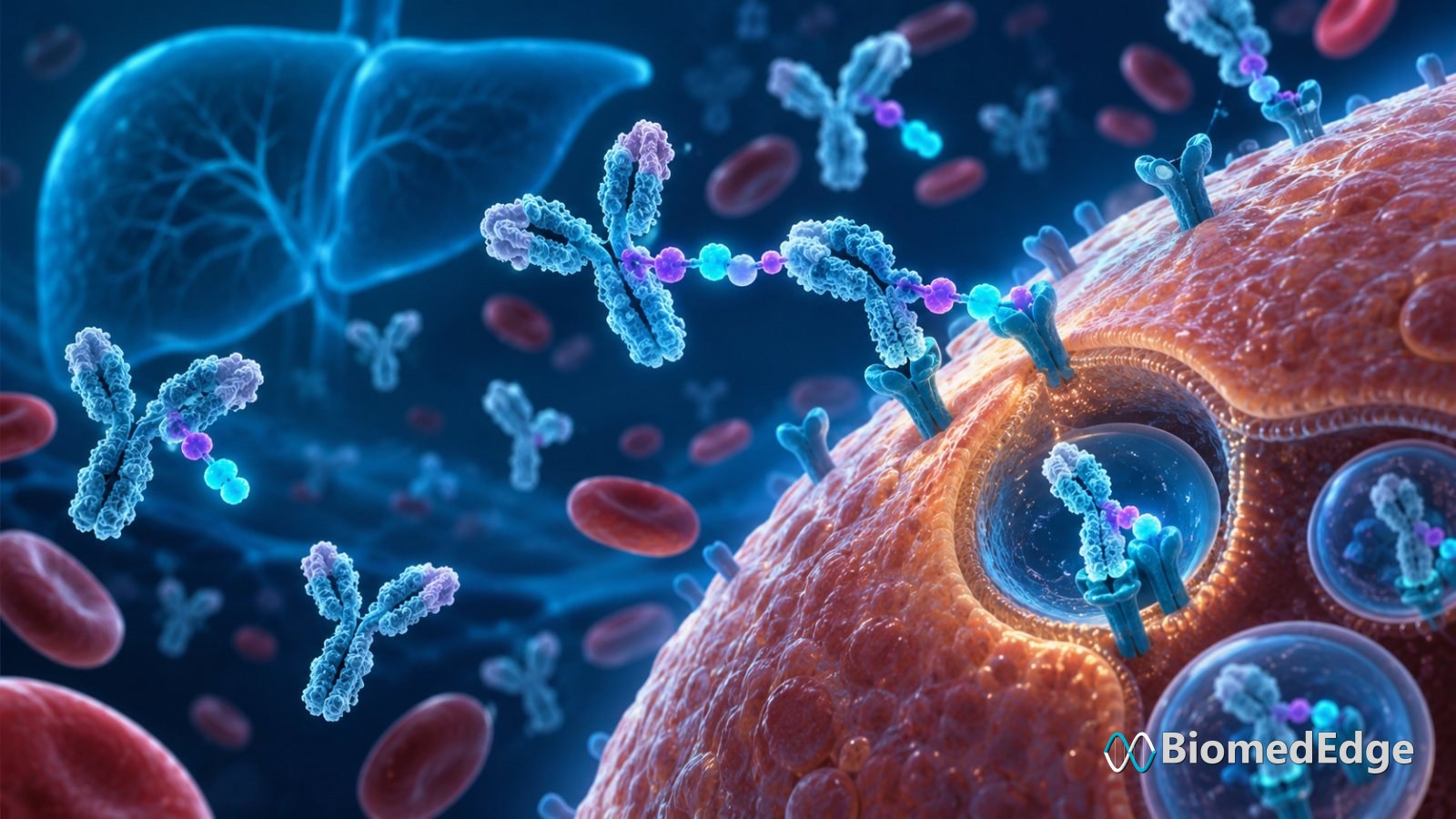
An $80 million upfront deal brings a new way of clearing autoantibodies to Asia. Here is how the liver-directed degraders work and what the early Graves' disease data do and do not show.
Ono Pharmaceutical has taken an exclusive licence to Biohaven's small-molecule IgG degraders in Japan, South Korea, Taiwan and the ASEAN countries. The deal, announced on 8 October 2026, covers the lead compound BHV-1300, now in a pivotal Phase 3 trial in Graves' disease, and two follow-on molecules, BHV-1310 and BHV-1320. Biohaven receives $80 million when the deal closes, a further $20 million milestone expected within a year, and royalties of about 20 percent on Ono's net sales in the territory. It keeps all rights elsewhere, including the United States, Europe and China.
The money is modest by licensing standards, and Ono says the effect on its results for the fiscal year ending March 2027 will be minor. What makes the deal worth a closer look is the technology. Both companies describe it as the first regional partnership for an extracellular protein degrader, a class of drug that removes circulating proteins rather than blocking them. If the approach holds up in Phase 3, it offers a different way to deal with autoantibody-driven disease than the antibody-based therapies that dominate the field today.
The problem: autoantibodies that current treatments leave alone
Graves' disease is the most common cause of hyperthyroidism. It is driven by autoantibodies that bind and activate the thyroid-stimulating hormone receptor (TSHR) on thyroid cells, so the gland keeps producing hormone without any signal from the pituitary. These antibodies are usually measured as TRAb. The disease tends to relapse and remit, and it often appears in women in their twenties and thirties.
Standard treatment has not changed in decades. Antithyroid drugs reduce hormone synthesis, while radioactive iodine and surgery destroy or remove the gland, after which most patients need lifelong thyroid hormone replacement. None of these options acts on the autoantibodies themselves. That is the gap Biohaven, and several competitors, are trying to fill.
How a MoDE degrader works
The MoDE platform (molecular degraders of extracellular proteins) came out of David Spiegel's laboratory at Yale, which described the approach in a 2021 paper in Nature Chemical Biology. Biohaven licensed it from Yale the same year.
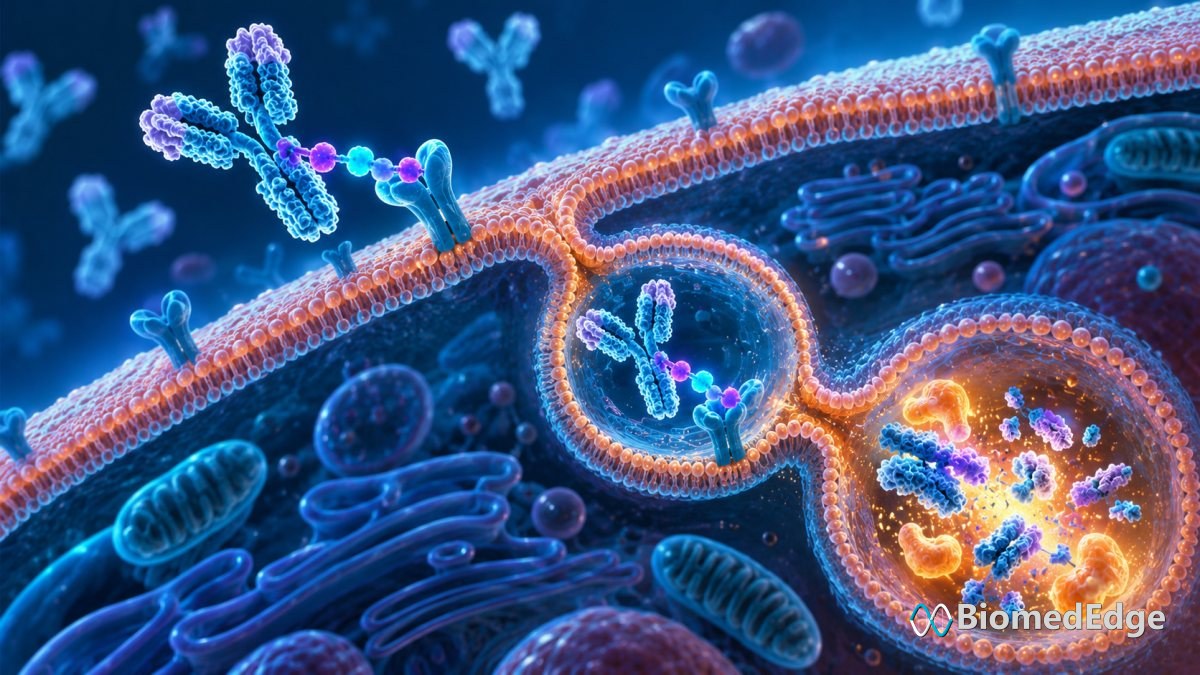
Each MoDE molecule is bispecific. One end binds the target protein in the blood, here IgG. The other end binds the asialoglycoprotein receptor (ASGPR), a receptor found mainly on hepatocytes whose normal job is to clear certain glycoproteins from the circulation. When the drug bridges the two, the liver cell takes the whole complex in by endocytosis and routes it to lysosomes, where proteases break the antibody down.
This differs from the better-known protein degraders in two ways. PROTACs and molecular glues work inside cells and depend on the ubiquitin-proteasome system, which limits them to intracellular targets. MoDE molecules act outside cells and use the endosomal-lysosomal pathway instead, so circulating proteins such as antibodies and cytokines become possible targets. They are also small molecules rather than engineered antibodies, which Biohaven says allows subcutaneous self-injection with an autoinjector.
BHV-1300 is designed to bind the IgG1, IgG2 and IgG4 subclasses and to leave IgG3 alone. The company's stated reason is to preserve normal immune effector function, since IgG3 is a strong activator of complement and contributes to some protective antibody responses. Because the TSHR autoantibodies measured in Biohaven's studies are of the IgG1 subclass, sparing IgG3 should not, in principle, weaken the effect on the disease-driving antibodies.
Why not just block FcRn?
The established way to lower IgG is to inhibit the neonatal Fc receptor (FcRn). FcRn normally rescues IgG from lysosomal degradation and recycles it back into the blood, which is why IgG has such a long half-life. Blocking FcRn lets IgG be degraded faster. Drugs in this class are approved for generalised myasthenia gravis and other antibody-mediated diseases.
FcRn inhibitors lower all IgG subclasses at once, and FcRn also recycles albumin. Some antibodies in the class have been linked to falling albumin and rising LDL cholesterol, which became a known issue for Immunovant's batoclimab. A degrader that pulls IgG out of the circulation directly does not need to interfere with FcRn, and Biohaven presents its safety data on albumin and cholesterol with that comparison in mind. No head-to-head data exist, so the comparison is a design argument rather than a demonstrated advantage.
The evidence so far
All of the clinical data on BHV-1300 come from Biohaven's own press releases and investor presentations. None have yet appeared in a peer-reviewed journal, and the numbers below should be read with that in mind.
- Healthy volunteers: in a Phase 1 multiple-dose study, subcutaneous BHV-1300 reduced total IgG by up to 87 percent, according to the company, while sparing IgG3.
- Graves' disease, Phase 1b: at 1,000 mg given subcutaneously once a week for 12 weeks, the mean reduction in TSHR-IgG1 was more than 80 percent by week 12. In three consecutively treated hyperthyroid patients who were also taking antithyroid drugs, free T4 normalised at a median of three weeks and free T3 at a median of five weeks.
- Safety through 12 weeks: adverse events were mostly mild and resolved on their own, with no serious or severe events and no discontinuations. Biohaven reported no clinically significant drops in albumin, rises in cholesterol or changes in liver enzymes, and no meaningful reductions in IgG3, IgA, IgE or IgM.
The thyroid-function result rests on three patients who were still on antithyroid medication, so it cannot separate the effect of the degrader from that of standard therapy. Biohaven said a larger biomarker dataset of eight patients would be presented at its May 2026 R&D Day, but the efficacy picture remains thin until the Phase 3 trial reads out.

The Phase 3 trial
The pivotal study (NCT07661056) began on 26 June 2026 and is recruiting in the United States, Canada and Puerto Rico. It plans to enrol about 300 adults with Graves' disease, randomised 2:1 to BHV-1300 or placebo, both given by subcutaneous autoinjector under double-blind conditions. The registry entry does not state the dose or schedule.
The primary endpoint is the number of participants who are off antithyroid drugs and have normal total T3, free T4 and TSH at week 26. That is a demanding measure, because it asks whether the degrader can control the disease on its own rather than alongside standard treatment, which is exactly what the Phase 1b data could not show. Primary completion is estimated for January 2028.
Why the deal matters for R&D strategy
For Ono, the licence adds a late-stage immunology asset at limited cost and with a familiar regional structure: the Japanese partner takes development, regulatory filings and commercialisation in Asia, while the originator keeps the large Western markets. Ono will need to run or join studies that satisfy regulators in Japan and its other territories, since the current Phase 3 sites are all in North America.
For Biohaven, the deal brings in near-term cash while keeping the most valuable territories. It also places an outside bet on a platform that has so far been validated only by the company itself. Biohaven is running a second extracellular degrader platform, called TRAP, whose lead compound BHV-1400 targets galactose-deficient IgA1 in IgA nephropathy. That programme is not part of the Ono agreement.
Competition in Graves' disease is real but unsettled. Immunovant says topline data from potentially registrational trials of its FcRn inhibitor IMVT-1402 in Graves' disease and myasthenia gravis are expected in 2027. It has stopped developing batoclimab in all indications after two Phase 3 trials in thyroid eye disease missed their primary endpoint. A positive readout for either approach would be the first disease-modifying treatment aimed at the autoantibodies in Graves' disease.
Limitations and open questions
- Small, company-reported datasets. The efficacy signal in Graves' disease comes from very few patients, without a control group, and has not been peer reviewed.
- Durability and remission. Lowering antibodies for 12 weeks is not the same as inducing remission. Whether TRAb levels and thyroid function stay normal after dosing stops is unknown.
- Liver-directed clearance. Routing large amounts of antibody through hepatocytes is new. Long-term liver safety, ASGPR saturation at high IgG loads and effects in patients with liver disease will need longer and larger studies.
- Infection risk. Sparing IgG3 is a reasonable design choice, but deep reductions in the other IgG subclasses could still affect protection against infection or the response to vaccines over long-term use.
- Dosing burden. The Phase 1b regimen was 1,000 mg weekly. The commercial dose and frequency are not yet public.
What to watch
- Peer-reviewed publication of the Phase 1 and Phase 1b data, including the full eight-patient biomarker set.
- Whether Ono starts its own studies in Japan or adds Asian sites to the global programme.
- Progress of the next-generation degraders BHV-1310 and BHV-1320, and which diseases they target.
- Immunovant's 2027 Graves' readout for IMVT-1402, which will set the bar for any IgG-lowering approach.
- The BHV-1300 Phase 3 result, expected after primary completion in early 2028.
This article is for information only and is not medical advice. Treatment decisions should be made with a qualified clinician.
Sources: Ono Pharmaceutical; Biohaven via PR Newswire; Pharmaceutical Technology; Biohaven, May 2026 data release (SEC); ClinicalTrials.gov NCT07661056; Immunovant via BioSpace; Spiegel Lab, Yale
What did you think of this article?
Found this helpful? Share it!
Comments (0)
Leave a Comment
Be the first to comment!